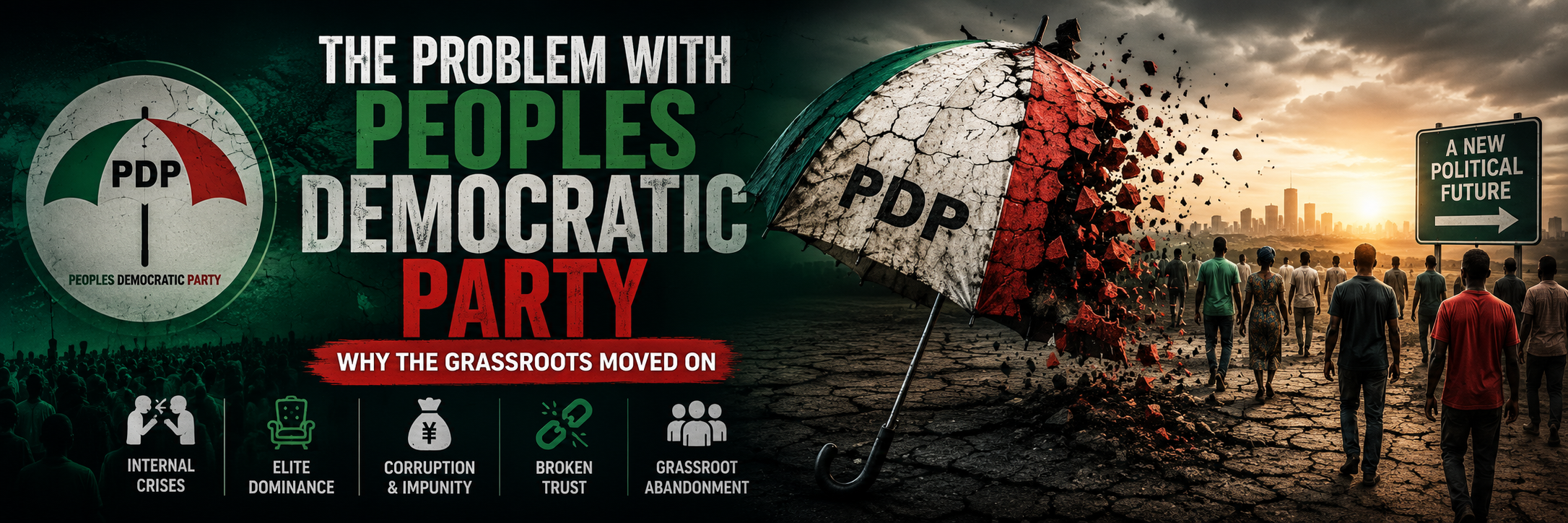
The Problem with the Peoples Democratic Party: Why the Grassroots Moved On

Stanley Agu
May 16, 2026 · 5 views
There was a time when the Peoples Democratic Party, PDP, did not just contest elections in Nigeria; it defined the political map. It had governors, federal power, national spread, financial strength, and deep structures across the country. For sixteen years, PDP looked like the permanent landlord of Nigerian democracy.
But today, that image has faded. The party still exists, still has big names, and still controls some states, but it no longer commands the same emotional loyalty from the grassroots. The problem is not that Nigerians have forgotten the PDP. The problem is that many Nigerians remember it too well.
For years, the party became associated with elite bargaining, zoning fights, candidate imposition, internal betrayal, and a political culture where ordinary members were useful during elections but ignored after victory. The grassroots watched as power was negotiated mostly among governors, former presidents, former vice presidents, senators, ministers, and party financiers. The people became spectators in a party that claimed to be theirs.
The 2015 defeat should have forced a deep internal rebirth. Instead, PDP treated it more like a temporary setback than a moral warning. By 2023, the old wounds had returned. The presidential primary reopened the North-South power argument. Atiku Abubakar’s emergence angered powerful blocs, especially the G-5 governors, and the party entered the general election divided, suspicious, and weakened.
Since then, the crisis has continued. Leadership disputes, court cases, defections, rival camps, and reconciliation committees have become part of the PDP story. A party that should be presenting itself as a government-in-waiting often appears to be negotiating its own survival.
That is where the grassroots began to move on. Some moved to Labour Party in 2023 because Peter Obi gave them a language of urgency and hope. Some moved into activism. Some joined smaller parties or coalition movements. Others simply withdrew into political cynicism. But the message was the same: people were tired of being used as election-day numbers while party elites recycled ambition.
PDP still has structure, experience, and history. But structure without trust is no longer enough. Nigerians are battling hardship, insecurity, unemployment, inflation, and broken public confidence. They want more than old slogans and familiar faces. They want a party that feels renewed, disciplined, and genuinely connected to ordinary people.
The PDP’s biggest problem is not APC, Peter Obi, or any rival party. Its biggest problem is its failure to convince Nigerians that it has truly learned from its fall.
Until PDP rebuilds from the ward upward, empowers credible local voices, ends endless elite quarrels, and offers a politics that feels morally different, it will remain trapped between memory and reality: too big to ignore, too damaged to fully trust, and too divided to inspire the grassroots it once claimed to own.